Website performance has become an important part of modern SEO. Search engines want to provide results that are not only relevant but also offer visitors a smooth browsing experience. This makes it important for website owners to understand how Core Web Vitals affect seo and what these metrics actually mean for search visibility.
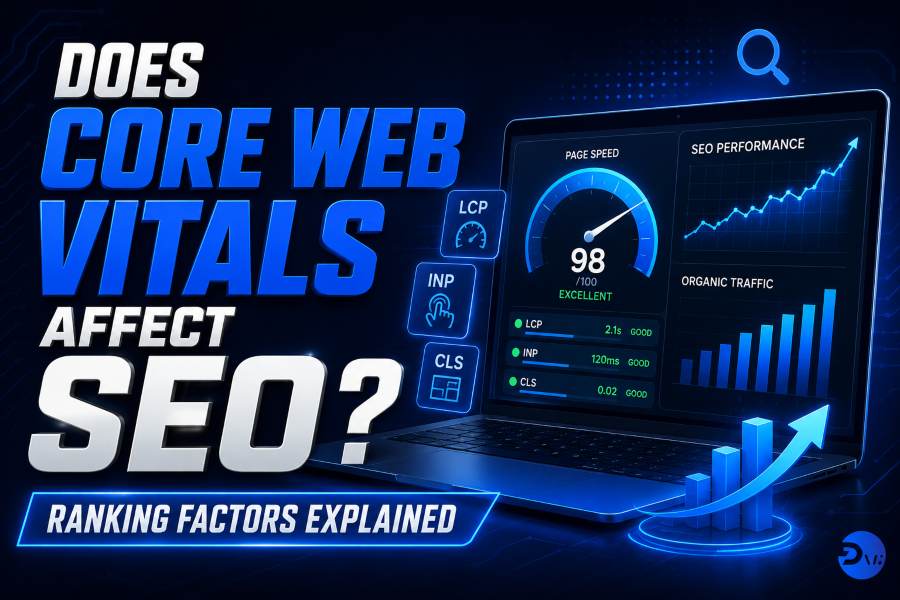
Core Web Vitals measure three key aspects of a user’s experience: loading performance, responsiveness, and visual stability. These metrics are Largest Contentful Paint (LCP), Interaction to Next Paint (INP), and Cumulative Layout Shift (CLS). Google uses real-world data to evaluate these experiences, while tools such as PageSpeed Insights, Search Console, and Lighthouse help website owners identify problems.
However, Core Web Vitals should not be treated as a shortcut to higher rankings. Content relevance, quality, search intent, technical accessibility, and other ranking systems remain essential. The real value of performance optimization is that it removes unnecessary friction while supporting a stronger overall SEO strategy.
What Are Core Web Vitals and Why Do They Matter for SEO?
Core Web Vitals are user-focused performance metrics designed to show how visitors experience a webpage. Instead of focusing only on server response times or technical measurements, they examine the user experience.
Largest Contentful Paint measures loading performance
LCP measures how quickly the largest visible content element becomes available. Google considers 2.5 seconds or less a good LCP result. Large images, slow servers, render-blocking resources, and excessive scripts can all delay the main content.
Interaction to Next Paint measures responsiveness
INP measures how quickly a page responds to user interactions. A good INP is below 200 milliseconds. Heavy JavaScript and long-running browser tasks can make buttons, menus, and forms feel sluggish.
INP replaced First Input Delay (FID) as a Core Web Vital in March 2024. This distinction matters because older SEO resources may still describe FID as a current metric.
Cumulative Layout Shift measures visual stability
CLS measures unexpected movement of page elements during loading. A good score is below 0.1. Reserving space for images, videos, advertisements, and dynamic content can help prevent disruptive shifts.
Together, these metrics provide a practical picture of page experience and help developers identify performance problems that visitors may encounter.
Why Do Core Web Vitals Matter for SEO?
The answer to whether Core Web Vitals affect seo is yes, but the relationship is more nuanced than simply saying better scores equal higher rankings.
Core Web Vitals are part of Google’s page experience signals
Google has confirmed that Core Web Vitals are considered by its ranking systems. This means performance can contribute to how pages perform in organic search.
However, Core Web Vitals are not the only consideration. A page with excellent performance does not automatically outrank a page with more relevant and useful content.
Content relevance remains essential
Suppose two pages provide similarly relevant answers to a search query. Stronger page experience can help when other important factors are comparable.
That is why website owners should optimize performance without neglecting content quality, topical relevance, technical SEO, and search intent.
Good scores do not guarantee top rankings
Passing Core Web Vitals does not guarantee a first-page position. Google’s ranking systems evaluate many signals, and no individual metric can secure a specific ranking.
The best approach is to treat performance as one component of a broader SEO strategy.
How Do LCP, INP, and CLS Influence Website Performance?
Understanding each metric makes optimization easier because each Core Web Vital points to a different type of user experience problem.
- LCP: Focuses on how quickly the primary content appears.
- INP: Measures how responsive the page is when visitors interact with it.
- CLS: Measures unexpected visual movement.
- Good LCP: Aim for 2.5 seconds or less.
- Good INP: Aim for less than 200 milliseconds.
- Good CLS: Aim for less than 0.1.
Review these metrics together rather than optimizing them in isolation. A page may load quickly but remain frustrating because interactions are delayed. Another page might respond instantly but shift its content while loading. Looking at all three provides a more complete understanding of the experience.
How Can You Improve Core Web Vitals for Better SEO?
Improving Core Web Vitals starts with measurement. Google Search Console shows aggregated Core Web Vitals information for eligible pages, while PageSpeed Insights combines real-user data with lab diagnostics. Lighthouse can also help developers investigate potential performance problems in a controlled environment.
Tracking SEO performance alongside technical improvements is also important. Tools like RankSyro can help website owners monitor important SEO factors and make better optimization decisions.
Improve LCP by optimizing critical content
Start with the largest element visible when the page loads. If it is an image, use an appropriately sized file and modern image formats where suitable. Improve server response time, reduce render-blocking resources, and avoid unnecessary delays to important content.
Lazy loading can help images below the fold, but don’t unnecessarily delay main above-the-fold content.
Improve INP by reducing JavaScript work
Excessive JavaScript can keep the browser busy and delay interactions. Review third-party scripts, reduce unnecessary code, and break up long tasks when possible.
Analytics, advertising, chat widgets, personalization tools, and other external scripts can all contribute to browser workload. Removing unnecessary scripts can improve responsiveness.
Improve CLS by reserving space
Images and videos should have defined dimensions so the browser knows how much space to allocate before they load. Advertisements and dynamically inserted components should also have predictable containers.
Avoid placing new visible content above existing content after the page has already started rendering.
Measure changes after optimization
Do not assume an optimization worked simply because a score improved in a laboratory test. Compare performance before and after changes and examine real-user data where available.
Browser environments can affect how users experience website performance, so tools like Browsiox can help users better understand browsing conditions and how websites behave across different environments.
This measurement-based approach prevents teams from spending time on low-impact improvements and helps focus efforts on changes that create meaningful improvements for visitors.
Which Tools Can Help Measure Core Web Vitals?
Google Search Console
Search Console provides a site-wide view of Core Web Vitals performance for pages with sufficient field data. It can help identify groups of URLs categorized as good, needing improvement, or poor.
PageSpeed Insights
PageSpeed Insights provides both field and laboratory information. Field data helps reveal how real users experience a page, while laboratory testing can help diagnose specific technical problems.
Lighthouse
Lighthouse performs controlled audits covering performance, accessibility, best practices, and SEO. Its results help diagnose problems, but its laboratory performance score should not be confused with a direct Google ranking score.
Chrome DevTools
Chrome DevTools can help developers investigate browser activity and identify issues such as long tasks and layout shifts. It is particularly useful when a technical investigation requires more detail than a simple performance score provides.
Field data vs. lab data
Field data comes from actual user experiences, while lab data comes from controlled testing environments. They can produce different results because users have different devices, networks, locations, and browsing conditions.
For SEO decisions, real-user Core Web Vitals data is especially valuable because it represents actual visitor experiences.
What Other SEO Factors Should You Optimize Alongside Core Web Vitals?
If you’re asking whether Core Web Vitals affect SEO, remember that website performance is only one piece of organic search optimization.
A strong SEO strategy should also address:
- Search intent — Create content that directly answers what users want to know.
- Content quality — Provide useful, accurate, original information.
- Technical accessibility — Make pages easy for search engines to crawl and understand.
- Mobile experience — Ensure pages work effectively across different screen sizes.
- HTTPS security — Deliver pages through a secure connection.
- Internal linking — Help users and search engines discover related content.
- Structured content — Organize information with clear headings and logical page structure.
Performance improvements become much more valuable when they support these broader SEO fundamentals rather than replacing them.
Conclusion
So, do Core Web Vitals affect seo? Yes. Google considers Core Web Vitals within its page experience and ranking systems, making website performance a legitimate part of modern SEO.
LCP evaluates loading performance, INP measures responsiveness, and CLS evaluates visual stability. Improving these metrics can create a faster, more responsive, and more predictable experience for visitors.
Still, Core Web Vitals should not become the sole focus of an SEO campaign. Strong content, relevance, technical accessibility, mobile usability, and search intent remain critical. The most effective strategy combines performance improvements with these fundamental SEO practices.
When you measure real-user performance, identify the biggest bottlenecks, and fix problems systematically, Core Web Vitals can become a valuable part of a healthier and more competitive website.
FAQs
1. Do Core Web Vitals directly affect Google rankings?
Yes. Google’s ranking systems consider Core Web Vitals part of its broader page experience signals. However, they are only one factor among many.
2. What are the current Core Web Vitals?
The current metrics are Largest Contentful Paint (LCP), Interaction to Next Paint (INP), and Cumulative Layout Shift (CLS).
3. What is a good Core Web Vitals score?
Google recommends an LCP of 2.5 seconds or less, an INP below 200 milliseconds, and a CLS score below 0.1 for a good experience.
4. Does a perfect PageSpeed score improve rankings?
Not necessarily. Laboratory scores from tools such as Lighthouse help with diagnosis, but a perfect score does not guarantee higher Google rankings.
5. Which Core Web Vital should I improve first?
Start with the metric that creates the largest real-world performance problem. Review your field data and then investigate the technical causes behind poor LCP, INP, or CLS.
6. Can improving Core Web Vitals increase organic traffic?
Improving performance can support SEO and user experience, but traffic depends on many factors. Better Core Web Vitals alone do not guarantee increased organic traffic.